The story
Where Aladdin comes from: a Syrian storyteller, a French translator and a lamp
The tale behind the musical was not in the original Arabian Nights manuscripts. How it reached Paris in 1709, who told it, and what the 1992 film changed.
Find my night ↗Quick answer
Aladdin is a Middle Eastern folk tale that Wikipedia says is not part of the original Nights text. The French translator Antoine Galland added it in 1710, from a story told to him by Hanna Diyab, a storyteller from Aleppo. The 1992 film, and the stage musical drawn from it, then reworked the tale: the sorcerer and the vizier became one villain, and the genie's wishes were limited to three.
A tale that was never in the manuscripts
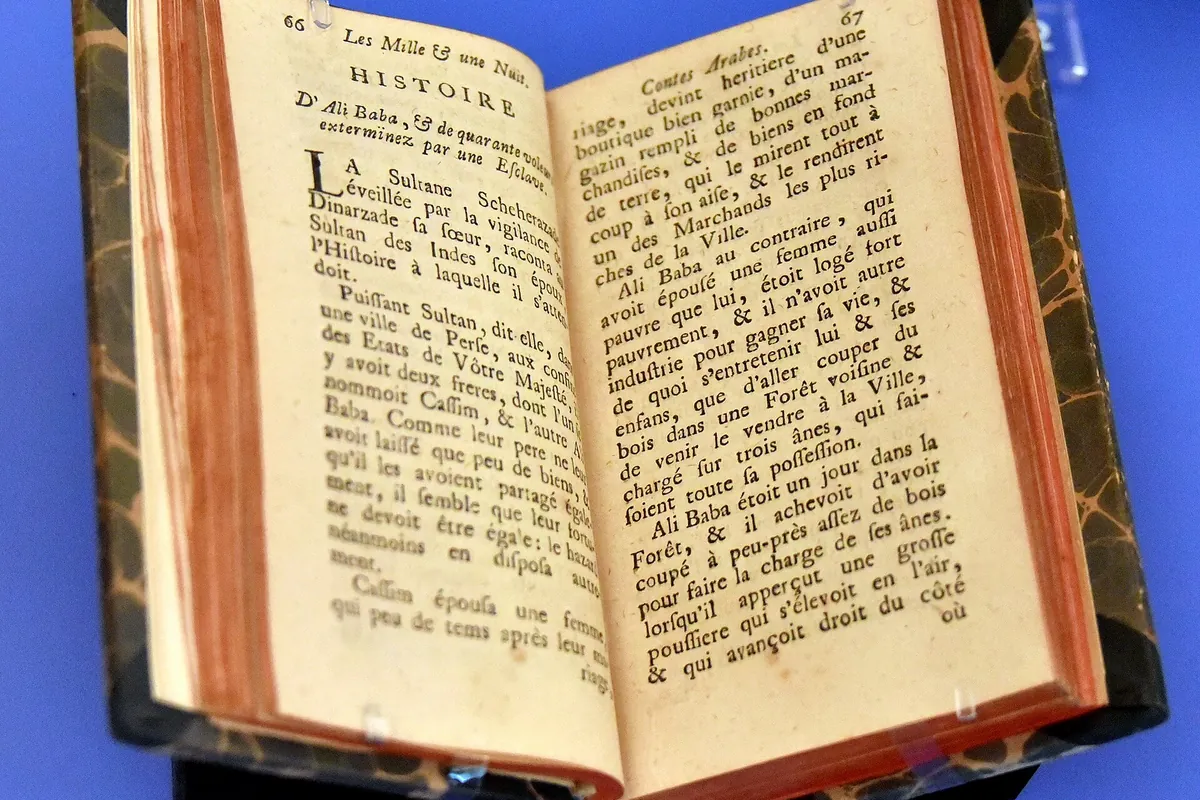
Most people assume Aladdin has always lived in the One Thousand and One Nights. Wikipedia says otherwise: the tale is one of the best-known associated with the Nights, yet it was not part of the original text. Together with Ali Baba, it belongs to the group scholars call the orphan tales, stories that appear in the collection without an early manuscript behind them. The man who put it there was Antoine Galland, a French orientalist whose version of the Nights came out in twelve volumes between 1704 and 1717. The scholar Muhsin Mahdi has also shown that two Arabic manuscripts that were once cited as sources for Aladdin are back-translations of Galland's French, which leaves Galland's French as the earliest record of the story that Wikipedia points to.
The storyteller from Aleppo
According to Galland's diary, as Wikipedia relays it, he met a Maronite storyteller from Aleppo named Hanna Diyab in Paris on 25 March 1709. Diyab had travelled to France with the French traveller Paul Lucas. He had worked for French merchants in Syria as a young man and had learned French and Italian, and he was telling tales to Galland so that the translator could finish his book. Galland wrote summaries of the performances and, for Aladdin, was given a manuscript. He transcribed the story over the winter of 1709 and 1710, and it appeared in the ninth and tenth volumes of his Nights in 1710, without any mention of Diyab. Diyab's own Arabic autobiography was translated and published in 2015, which widened what is known about him.
Who wrote it?
The question of authorship is live. Wikipedia reports that the literary scholars Ruth Bottigheimer and Paulo Lemos Horta have argued that Diyab should be understood as the original author of some of the stories he supplied, and that several, including Aladdin, were partly inspired by episodes in his own life, since the autobiography contains parallels. That is an argument, not a settled fact, and a visitor to the musical does not need to take a side. It does explain why the story feels so concrete: a poor young man, a sudden rise, a scheming adviser and a city full of merchants read like the work of someone who had watched trade and ambition at close range.
A city in China, a sorcerer from the Maghreb
In Galland's text, and in Richard Burton's later English version, the story opens in one of the cities of China. A sorcerer from the Maghreb, who claims to be the brother of Aladdin's dead father, persuades the boy to fetch an oil lamp from a magic cave. Wikipedia points out that almost everything after the opening sentence reads as Middle Eastern: the ruler is a Sultan, the people are Muslim, and the dialogue is full of Muslim phrases. It adds that early Arabic usage of China could simply mean a far-off, exotic land. The setting is therefore less a map reference than a way of saying this happened a long way away, which is useful context for a musical set in the invented city of Agrabah.
What the film and the stage show changed
The 1992 animated film reshaped the tale for a family audience. Wikipedia notes that several characters were renamed or combined: the sorcerer and the vizier became a single villain, Jafar, and the princess became Jasmine, where the tale gives her a name meaning full moon of full moons. The genie of the lamp grants only three wishes and longs for freedom, a new motive. The stage musical keeps that film storyline, with a book by Chad Beguelin, and adds a trio of friends for Aladdin who took the place of the film's monkey. If you want to see where a modern audience meets the old tale, the carpet, the lamp and the market are the parts that survive the journey.
Frequently asked questions
Is Aladdin in the original Arabian Nights?
Wikipedia says the tale was not part of the original Nights text. Antoine Galland added it to his French version in 1710.
Who told Galland the story?
Hanna Diyab, a Maronite storyteller from Aleppo, whom Galland met in Paris in 1709.
Sources